Lacquerware
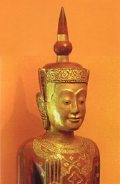
Cambodian traditional lacquerware reached its peak between the 12th and 16th centuries. Some examples of these wares have survived in the form of gilded Buddha images and betel boxes in the shape of elephants, pumpkins, and others. The traditional colours of Cambodian lacquerware were black, from burnt wood, red, from mercury, and yellow, from arsenic. These three colours represented the underworld (black), the earth (red) and the celestial realm (yellow or gold). Some Angkorian stonework shows traces of pigment dating from the 15th or 16th centuries.
Despite the rich tradition of lacquerwork in East Asia, at one time in Cambodia, these skills had almost completely died out and few lacquer trees had survived. In 1998 it was not possible to buy lacquer in Cambodian markets – a situation that has changed today with the establishment of new plantations. Some lacquered masks for performing artists were still made, with lacquer sourced from family-owned trees.
Through the training of a French expert, today some 100 lacquer specialists work with
Artisans d'Angkor producing illustrated panels for the souvenir market. The work is completely done by hand, with resin applied to rubber wood as a base. Repeated applications mean that it takes 45 days to make a finished piece.
This highly-skilled and exacting craft is still in its early stages of revival. As with other traditional crafts, artisans are beginning to experiment with different techniques and styles, adding rice grains, eggshell, rice stalks and sandstone chips (for example) to produce modern and striking effects.


