Stone carving
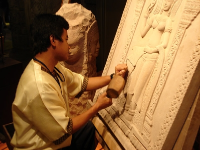
Traditional stone carving is most closely associated with Cambodian pagodas, in particular its Angkorian temples, renowned for the scale, richness and detail of their sculpture. However the craft of large-scale stone carving was little practiced in recent times and had almost completely died out after the upheaval of the 1970s and 1980s.
In a way traditional stone carving seems to have been a victim of its own success. With no temperature extremes to contend with, the Angkorian temples and the carvings they housed lasted undamaged for centuries, before experiencing the large-scale looting of Cambodia’s post-1970s environment. There had been no need, previously, for its carvings to be replaced. Meanwhile, stone or wood carving for newer pagodas was no longer needed as cement moulds came into use, so the skill base slowly disappeared.
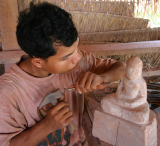
When international restoration efforts began to focus on Angkor in the late 20th century, there began to be a demand for skilled stone carvers to fill in damaged or missing sections.
Chantiers-Écoles de Formation Professionelle (CEFP), a Cambodian government institution established with French funding in the temple town of Siem Reap, introduced training in stone carving to meet this need.
Artisans d'Angkor, the organisation created out of this training programme, today employs most of these carvers, producing commissions to order and making souvenir items such as busts of Jayavarman, Buddha images,
apsara dancers and small-scale
bas-reliefs.
Most carvings today are made from 400 million year-old sandstone quarried from Banteay Meanchey. Stone from Pursat and Kompong Thom is also used. Government regulations today reserve stone from Phnom Kulen – the original source of stone used in the Angkor temples – for restoration purposes only.
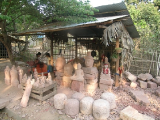
Traditional-style carving is the priority, but carvers are beginning to experiment with the form to produce more modern works. Domestic commissions also indicate the beginning of interest among Cambodians in reviving this heritage in modern-day
wats. In May 2004, a 15-person team of carvers from
Artisans d’Angkor completed a seven metre-high Buddha statue for Wat Samrong in Battambang, commissioned by Cambodian jeweller Hoeu Sarath.


