Ceramics
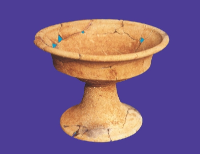
Some of the earliest Khmer pottery remains found in the country date back to 5000 BCE. Ancient kiln sites have been found at
Phnom Kulen and around the Angkor region, and at Sisakhet, Surin and Buriram provinces in present-day Thailand. Recently over 20 separate kilns were found at
Choeung Ek, better known to tourists as the one of Cambodia’s ‘killing fields’ during the Pol Pot regime.
Khmer ceramics were mainly used in everyday life, as water and rice containers and as food bowls. Ceramics from other countries, in particular China, were imported from the 10th century. There is no evidence to show that the strong and dense local Khmer ceramics were ever exported, and the more well-off people are thought to have used household utensils of bronze or imported ceramics. Between the 11th and 13th century, animal-style wares in the shapes of birds, elephants, rabbits and others appeared; similar shapes are made today as boxes of wood and silver.
Khmer potters used two potting techniques: the pottery wheel on which the clay pot is thrown, and a paddle and anvil technique. Ancient clay kilns were able to fire stoneware ceramics to a temperature of 1,000-1,200 degrees centigrade. Potters also fired their pots in the open air at a much lower temperature of around 700 degrees centigrade. The principal glazes used were green and brown.
In the countryside, traditional methods continue. Many of the pottery pieces are still hand-turned, then fired on an open fire with no glaze. The resulting items, used as cooking pots and other household items, are not waterproof and are liable to crack in the firing.
Today traditional pots are still displayed and sold from oxcarts filled with straw to cushion their journey over bumpy roads. Journeys can take many weeks. Kompong Chhnang Province, three hours’ drive from Phnom Penh, (chhnang means pot) is a major centre for Khmer pottery.
Owing to the efforts of
Cambodian Craft Co-operation (CCC) and other NGOs, potter’s wheels, gas kilns and more sophisticated glazes are nowadays also used and many new designs have been introduced for art objects and souvenir items. Local markets however sell mainly household crockery from Việt Nam and Thailand.


