Silk weaving
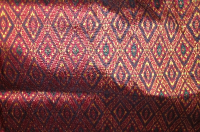
Silk weaving has a history in Cambodia dating from as early as the 1st century. Angkorian records carved in stone refer to textiles that were used to trade land and slaves, and fabrics used to dress statues of divinities. Clothing details on old stone sculptures are suggestive of the motifs and symbols found on woven silk. However this ancient tradition was little documented until the early 20th century, when the work of various French scholars – Jean Stoeckel in the 1920s, Jean Delvert and Eveline Poree-Maspero in the 1950s, and Bernard Dupaigne in the 1960s – captured details of weaving methods and motifs that are still widespread today.
The main silk-weaving areas today are Takeo, Battambang, Beanteay Meanchey, Siem Reap and Kampot provinces. Takeo is one of the main centres, with an estimated 10,000 weavers in the province, mostly operating out of their own homes. In the late 19th and early 20th centuries, Battambang was the main centre for silkworm production, but indigenous sericulture later died out, and today Cambodian weavers mostly use yarn and dyes from Việt Nam. Over the past 10 years, donor aid has been directed towards reviving sericulture and the use of traditional dyes. New technology such as propeller looms, metallic reed and winding frames have been introduced.
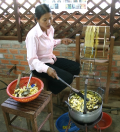
Cambodian silk is most often used domestically to make
sampot, the traditional Cambodian wrap-skirt. The traditional
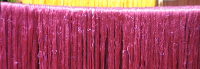
sampot hol comes in more than 200 patterns, combining three to five basic colours: yellow, red, black or dark brown, blue and green. Traditional dyes come from plants and insects: red from the nest of the
lac insect, yellow and green from the bark of the
prohut tree, blue from indigo, and black from the bark of the
maklua (ebony) tree. Today the use of silk in furnishing fabrics is also popular.
Also woven from silk are the traditional pidan, Khmer pictorial silk cloth used as canopies and temple tapestries in weddings, funerals and Buddhist ceremonies. Pidan commonly feature apsara motifs, scenes from the life of Buddha, temples, nagas, white elephants, Angkor Wat and various flora and fauna. During the years of civil strife, many old pidan were destroyed or taken overseas.
The
Institute for Khmer Traditional Textiles (IKTT) in Siem Reap has collected samples of antique textiles for preservation and at present has more than 200 examples in its collection. Some of the oldest examples of Khmer silk with an established provenance are in the American Museum of Natural History in Washington DC, and in London’s Victoria and Albert Museum.
There are two main types of weaving: the ikat technique, which produces patterned fabric, and twill woven fabric, which produces single or two-colour fabrics with an array of associated shimmering tones.
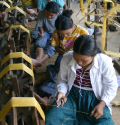
The
ikat technique, which is called
chong kiet in Khmer, is highly intricate and involves tying and dying of sections of the weft yarn in order to create patterns before weaving. Designs are not traced on paper but are tied directly onto the weft yarn from memory.
There are many traditional patterns and motifs, some of them unique to particular regions. Lattice designs and patterns of stars and spots are common.
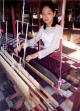
The twill woven fabric comes in 52 different colours.
Pamung chorabap, one of the most luxurious fabrics woven in Cambodia today, uses up to 22 string needles. The ‘uneven twill’ technique is unique to Cambodia and involves weaving with three threads so that the colour of one thread dominates on one side of the fabric, while the two others determine the colour on the reverse side.
Cambodian ‘yellow’ silk comes from a silkworm indigenous to Cambodia that produces a fuzzy yarn, giving the finished silk a unique shimmering quality and strength. Though once widely used, the yarn had been superseded by cheaper products from outside Cambodia since around 1970. Current efforts are being made to revive the sericulture and weaving of this silk, and the yarn now can be found on the market in Phnom Penh and Takeo.
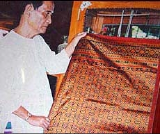
The establishment of the Silk Forum in 2003, a grouping of mainly foreign silk traders and promoters based in Phnom Penh, indicates the high degree of local interest in the potential overseas market for Cambodian silk. NGOs such as
Lotus Pond and
Tabitha Cambodia have supported countryside weavers to come up with modern designs and marketed the products as high-end luxury items, yet Cambodian silk still remains less well-known than its Thai and Vietnamese counterparts, in part due to higher production and transport costs in the dollarised Cambodian economy.
Nevertheless, the silk revival has been one of the success stories of the Cambodian crafts scene. Due to intensive training efforts from aid organisations and a growing domestic market, production is thought to have doubled in the last decade and the industry provides home-based employment for many rural women. Cambodian silk is still entirely handmade and the use of natural dyes has been revived. Efforts are being made to re-establish, in village settings, the trees, plants and insects that provide the traditional dyestuffs. While the domestic market is still the most important, there is thought to be great potential for Cambodian silk to find its place in the international arena.


