Heian-kyo (794-1331)

The design of Heian-kyo (Kyoto) was very similar to that of Heijo-kyo. Measuring 5.5 kilometres from north to south and 4.7 kilometres from east to west and surrounded by a moat, it was laid out in a grid pattern with the palace compound in the north. A central thoroughfare known as the Suzaku-oji led from the Rajomon or main city gate to the Suzakumon or main gate of the palace compound. Housed in a 1.4 kilometre by 1.2 kilometre rectangular walled enclosure, the Greater Palace compound itself contained several inner enclosures.
The Chodo-in compound housed the Daogokuden or Great Audience Hall together with 12 other ceremonial halls. It was here that the emperor presided over state affairs and ceremonies and received foreign visitors. To the west of the Chodo-in compound was the Buraku-in compound, which was built for official celebrations, banquets and other kinds of entertainment, and contained a hall known as the Burakuden in which the emperor and court presided over activities.

Located behind the Daogokuden, the Dairi or Inner Palace was enclosed within two sets of walls. At its centre was the Shishinden (Hall of State) and behind that the Jijuden and the Shokyoden (subsidiary halls). Other buildings within the Inner Palace included the emperor's private quarters, the residences of imperial consorts and ladies-in-waiting, and a number of other official and ceremonial buildings. Heian Shrine, a half-sized reconstruction of the Dairi complex which incorporated the Hall of State, is today located to the east of the original location.
The remainder of the Greater Palace compound was occupied by the buildings of the Daijokan (Council of State), ministries and other government offices, workshops and storage buildings.
Following its first flowering in the Nara period, the
shinden-zukuri style of palace architecture reached maturity during the Heian period. This style not only dictated the design of imperial palace buildings at Heian-kyo but was also increasingly adopted by the court aristocracy, who were given rectangular blocks of land immediately outside the Greater Palace compound and began modelling their homes on that of the emperor.
Flanking the Rajomon or main city gate were Sai-ji Temple (West Temple) and
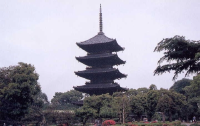
To-ji Temple (East Temple) – today Sai-ji no longer exists but To-ji remains and its pagoda, the largest in Japan, remains a dominant feature of the cityscape. The city also included various other types of building, including markets, townhouses and shops. According to one estimate, the capital had a population of around half a million people.

The residential function of the palace continued until the 12th century, but the facilities built for grand state ceremonies began to fall into disuse as early as the 9th century. This was due to both the abandonment of several statutory ceremonies and procedures and the transfer of several remaining ceremonies into the smaller-scale setting of the Inner Palace.
Made largely from wood, Heian-kyo suffered repeatedly from fires and other disasters. During reconstructions the emperors and some of their court functionaries resided outside the palace, leading in the Kamakura period to the practice of requiring high-ranking nobles to build sato dairi (temporary residences) suitable for appropriation by the court in the event of crises such as fire or war.
Finally in 1331 the court decided to convert one of these temporary residences - the Tsuchimikado Dono of the Fujiwara clan, located some two kilometres east of the original compound – into a permanent new palace. The original site was abandoned and subsequently built over, so that almost no trace of it now remains. Knowledge of the original palace of Heian-kyo is thus based on contemporary literary sources, plans, paintings and archaeological evidence.


