1980-present
In the 1980s advances in technology brought the information society with decentralisation, diversity and fragmentation. The notion of the post-modern influenced academics, writers and artists, and digital technology contributed significantly to the development of post-modern art works.
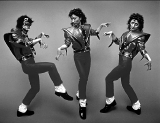
Yasumasa Morimura tried to examine post-modern Japan and western culture by using his body and technology. He photographed himself in the composition of paintings from masters such as Van Gogh, Manet, Duchamp and Jakuchu, a Japanese Edo-period painter, and photographed himself disguised as pop stars including Madonna and Michael Jackson. He manipulated his photographs by computer to create the images. He had a joint exhibition with Cindy Sherman, and his work with Shinro Otake, Hiroshi Sugimoto and others was shown at the exhibition entitled 'Cabinet of Signs' at the Tate Liverpool in 1991.
In the 1980s he taught at
Kyoto City University of Arts, where his fellow students included Tomoaki Ishihara, Chie Matsui, Miwa Yanagi and the founder members of
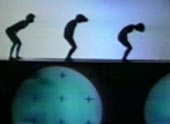
Dumb Type - Toru Koyamada, Yukihiro Hozumi, Shiro Takatani, Takayuki Fujimoto, Hiromasa Tomari and the late Teiji Furuhashi - whose work portrayed a dark, cynical, and humorous world in which technology is a way of life, if not necessarily a welcome one.
Ideal Copy was set up in 1988 in Osaka as an anonymous artists’ group which invited different artists to make arts and music. Yukio Fujimoto, music theorist and artist, was considered the core member.
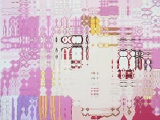
Tatsuo Miyajima’s work mixes traditional oriental philosophy and technology. His piece
Floating Time uses digital numbers made in LEDs to reflect the Buddhist notion that time keeps changing.
Mariko Mori works with computer-manipulated photographs and video. Her exhibition at London's Serpentine Gallery in 1998 represented Japanese tradition using digital technology. Her big shrine-like sculpture was displayed at the 2000 Apocalypse exhibition at the Royal Academy of Arts in London.
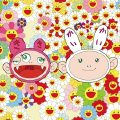
The boundary between arts and popular culture has become blurred in Japan. Takashi Murakami, who has a PhD in Japanese traditional painting from
Tokyo National University of Fine Arts and Music, took elements of popular culture - particularly
manga - into his works. He curated a show called
Super Flat in the USA, exploring his ideas of Japanese arts and philosophy and examining western modernisation in a Japanese context. He actively promotes talented young artists through events such as the annual
Geisai (Art Festival) at the
Tokyo Metropolitan Museum of Contemporary Art, in which any young artist can participate.
Yoshitomo Nara, from the same generation as Murakami, created manga-like child figures in his paintings and became an icon and almost a pop idol to the younger generation.
In the 1990s young artists began setting up their own studios as exhibition spaces and curating arts events. Masato Nakamura organised
Ginburart, marching through the Ginza area in central Tokyo.
The Small Village Centre was established by Tsuyoshi Ozawa and Takashi Murakami as a parody of the High Red Centre of the 1960s; and guerrilla-type events were also held in different locations.
commandN, an artist-run alternative space and group organised
Akihabara TV in the electronics area of Tokyo, introducing international video work by displaying it on TV screens in hundreds of shops.

The Artists born in 1965 group, founded by Makoto Aida, Hiroyuki Matukage, Muneteru Ujino and Kazuhiko Hachitachi, organised
Showa 35 Kai.
The Kansai region is considered to have generated a new wave of artists, including Miwa Yanagi, Shimabuku, Tadasu Takamine, Zon Ito and Tabaimo. Their art attracts the younger generation. The Yokohama Triennale, a showcase of Japanese and Asian contemporary arts, is scheduled for 2005.


