1868-1945
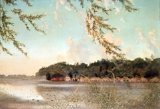
When western arts and arts studies came to Japan during the Edo period, they were dominated mainly by the Netherlands, one of the official countries allowed to trade in Japan. After the Meiji Restoration in 1868, Japan finally opened up the country and western modernisation came in more widely as the Meiji government persuaded Japanese artists and scholars to explore and assimilate western culture.
Thereafter western art techniques were brought in rapidly. The newly-introduced western-style oil painting was named yoga, while the Japanese-style painting, characterised by the use of unique perspective, forms and colours from mineral pigments on paper or silk, was called nihonga. Distinguished yoga artists in the period from the late 19th to early 20th centuries included, amongst others, Yuichi Takahashi and Seiki Kuroda.
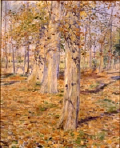
After 1868 Japan began to be more influenced by Britain, France and Italy. When the government opened an Art School in 1878 within the Imperial College of Engineering
(Kobu Bijutsu Gakko) in Tokyo, painter Antonio Fontanesi and architect Giovanni Vincenzo Cappelletti from Italy were invited to come and teach at the School in order to train students in sophisticated and technically-developed Italian arts and techniques.
Created with the aim of teaching western arts techniques, the School emphasised the idea of painting objects in a naturalistic way rather, than from an aesthetic point of view. This was partly because it was believed that western perspective and technique was superior to traditional Japanese painting, and partly because of the necessity of realistic painting for scientific use. However, the school was closed in 1883.
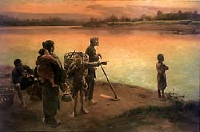
In 1878 Ernest Fenollosa was appointed as a professor of philosophy at the Imperial University of Tokyo, and in 1887 he helped to found the Tokyo School of Fine Arts (
Tokyo Bigakko), the first national art academy in Japan and forerunner of the
Tokyo National University of Fine Arts and Music.
Eager to revise the value of Japanese traditional arts, Fenollosa also amassed a huge collection of mainly Buddhist traditional art object, and suggested to the Japanese government that the Japanese traditional arts should be protected and promoted. Fenollosa assisted in the setting up of the Imperial Museum, becoming its Director in 1888, and when in 1981 he went back to the States to became Director of the Oriental Art Department of the Boston Museum of Fine Arts, he bequeathed the bulk of his collection as the core collection of the museum.
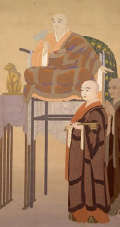
At the time of the establishment of the Tokyo School of Fine Arts (
Tokyo Bigakko), the nationalist movement had emerged as a reaction to the hasty promotion of western arts. Major art exhibitions and institutions rejected western paintings. Tenshin Okakura, the head of the School, strongly supported the protection and revitalisation of Japanese traditional arts, and at first the curriculum was restricted to Japanese traditional arts. Under the enthusiasm of Okakura, many talented young Japanese painters were taught here. Shunso Hishida was one of Okakura’s most distinguished students; his skill was to combine the Japanese notion of space with western realism in a very sensitive way. Like him, young Japanese painters were trying to find ways to adapt western realism and technique into Japanese paintings. Kokei Kobayashi and Seison Maeda should be noted as important
nihonga artists from the Meiji to Showa periods.
Seiki Kuroda came back to Japan in 1893 after nine years' study, mainly in France, and started teaching western methods along with other artists, including Keiichiro Kume. In 1896 the government appointed Seiki Kuroda as the first Japanese professor at the Department of Western-style Painting at the Tokyo School of Fine Arts. Kuroda, Kume and other friends and colleagues also set up the White Horse Society (Hakubakai) in order to promote western-style painting in Japan. This rivalled the Pacific Western-style Painting Society (Taiheiyogakai) promoted by Naojiro Harada, Hisashi Matsuoka and others who had also studied abroad.
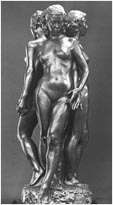
In the sculptural field, following the designation of Shinto as the state religion in 1868, many Buddhist images were destroyed and Japanese traditional wooden sculpture, especially Buddhist sculpture, was in danger. However owing to a re-evaluation by Ernest Fenollosa, interest in Japanese wood sculpture was revived. Koun Takamura, Komei Ishikawa and others were amongst those who pursed new possibilities in Japanese traditional sculpture at this time. Western sculptural techniques were also introduced into the syllabus of the Art School of the Imperial College of Engineering by Italian sculptor Vincento Ragusa prior to its closure in 1883. Morie Ogiwara, Moritaka Naganuma and others, back in Japan after studies abroad, also helped to promote western-style sculpture. Fumio Asakura should be noted as a highly gifted western-style sculptor from this period.
Bunten, art exhibitions organised by the Ministry of Education, were first held in 1907 after the model of the Salon de Paris. While their main purpose was to promote Japanese arts and culture, they focused on institutionalised arts activities and the bureaucratic legitimacy of artistic activities within a Confucian-style master-pupil hierarchy.
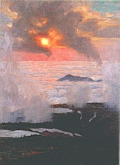
To oppose this bureaucracy, artists organised groups around their own concepts so that it was easier to promote their work. Tenshin Okakura established
Nihon Bigots-in (Meiji Art Society) with Taikan Yokohama, Shunso Hishida and other pupils to promote Japanese-style painting. Western-style painting groups called
Nikakai (Second Division Society), set up by Seifu Tsuda, Ryuzaburo Umehara, Sotaro Yasui, Tetsugoro Yorozu and others in the period 1910-1920, were strongly influenced by Fauvism and Futurism and led the Japanese
avant garde movement. The other main western-style painting group of this period was the
Shunyokai (Spring Sun Society), led by Ryusei Kishida. The annual
Bunten, renamed in 1919 as the
Teiten (Teikoku Bijutsu Tenrankai) or Imperial Arts Exhibition, was more rigorously controlled by the government.
During the 1920s, the Tokyo Great Earthquake, recovery from World War I and poor labour conditions caused social instability. Socialist and communist movements and activities became vigorous. The rise of military government and the social climate became more hostile to democracy. Many activists were suppressed or dismissed. In the 1930s the military government suppressed the self-expression of artists, especially avant garde rebels and the Japan Proletarian Artists’ League, and paintings became dark and abstract.
During World War II many western-style painters were deployed as war documentary painters, one of the most noteworthy being master painter Tsuguji Fujita. The war paintings were confiscated by the Allies after the war but many of them are now on permanent loan to the
National Museum of Modern Art, Tokyo.


