1945-1980
This was was a statement by the Japanese government that Japan would be an arts-oriented nation. Then in 1949 the government Tokyo Fine Arts School and Tokyo Music School were combined to create the
Tokyo National University of Fine Arts and Music.
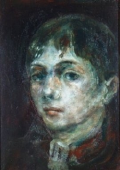
Throughout the period of suppression before and during the war, some artists had tried to advocate the autonomy of artists. Shunsuke Matsumoto was one of the artists who had challenged military control by drawing a series of dark self-portraits, which carried a mood of isolation. After the war, he advocated an independent artists’ union opposing state-controlled arts exhibitions. However he died in 1948.
Despite of the efforts of individual artists such as Matsumoto, Nikakai and the Free Arts Association (Jiyu Bijutsu Kyokai), the Japanese arts scene in the post-war period continued to be characterised by the institutionalisation of arts exhibitions and groups. However, in 1949 the Yomiuri Independent Exhibition was launched with the aim of allowing anyone to exhibit their art works.
Just after the war, Fauvism in the manner of the École de Paris, carried over from the pre-war period, was the main movement. Social realism, depicting the mood of post war society, was also popular. However, arts activities in Japan were still limited, partly because of the lack of information and materials, and also because of censorship by the Allied occupation until 1952. In the 1950s Japan's economy benefitted from the special economic demand created by the Korean War, which helped to reconstruct devastated land. But rapid economic recovery and industrialisation caused social conflict.
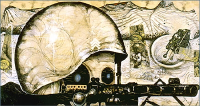
Some artists went to places where farmers were forced to leave their land because of the construction of dams, US military bases and so on, in order to paint what was really happening from direct experience. This art activity was called 'Reportage Art' and presentations varied from Realism to
avant garde. It raised the argument about the definition of Japanese Realism amongst artists and art critics. The distinguished playwright and novelist Kobo Abe called it 'the Third Realism', arguing that 'it should be called realism as it is a method which is deeply related to current social problems.....but it does not necessarily need to employ the traditional method of realism.' For example Taro Okamoto, an artist, famous for his
avant garde expression, painted social problems of alienation in a futuristic way.
Several other notable artistic movements started in the 1950s. Works by On Kawara from the beginning of the 50s called Misshitsu no Kaiga (Secret Room Painting), presented the alienation of people. Artists seeking new ways of presenting arts through the integration of art forms and technology set up the Experimental Laboratory (Jikken Kobo). Its name was given by Shuzo Takiguchi, an artist and art critic famous for introducing Marcel Duchamp’s work to Japan, and its members included artists from different genres such as media, music, sculpture, lighting, painting and art criticism. It presented a series of experimental exhibitions and performances combining contemporary music and visual arts. Composer Toru Takemitsu was one of the collaborators. The movement was connected to the Happening and Fluxus movements in the west.
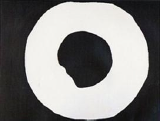
In the mid 1950s artists living in western Japan (Hyogo, Osaka and Kobe) established an
avant garde artists’ group called the Concrete Art Society (
Gutai Bijutsu Kyokai), Jiro Yoshihara, Shozo Shimamoto, Atsuko Tanaka, Akira Kanayama and Kazuo Shiraga were members. Their philosophy was based on existentialism and many of their activities were within the Happening movement, eg Kazuo Shiraga's 'foot' paintings, Saburo Murakami's performance of running through paper screens to present time through sound, and Atsuko Tanaka's dresses covered with millions of flashing light bulbs.
In the 1960s, as a part of the response to social contradiction and conflict, anti-arts movements became active. They challenged social institutions and the boundary between high arts and non-institutionalised arts, with the concept that anything could be art but all could not be art.
In Tokyo, Neo-Dadaist Organisers was set up by Shusaku Arakawa, Ushio Shinohara and Genpei Akasegawa, and the Kyushu School (
Kyushu-ha) by Kikuma Kikubatake, Osamu Ochi and others. A series of absurd street performances and exhibitions by High Red Centre, organised by Jiro Takamatsu, Genpei Akasegawa and Nakanishi Natsuyuki, questioned the institutionalisation of people’s activity by the nation. Alexander Monroe curated the ‘Beyond the Sky’ exhibition in 1995 at
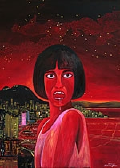
Yokohama City Museum of Art and the Japan Society in New York, featuring many of these activities. From the mid-1960s pop-arts were also popular, reflecting urbanism. Graphic designers such as Tadanori Yokoo and Kyoshi Owazu produced distinguished, artistically-designed posters.
An International Exposition was hosted in Osaka in 1970 with the theme of Arts and Technology, and Japanese artists, designers and architects were invited to contribute. Taro Okamoto created a monumental avant garde tower, Taiyo-no To (Tower of the Sun), for the occasion.
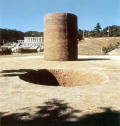
From the late 60s, and especially after the technology-oriented Expo '70, some artists began to display critical views of western modernism. The Material School (
Mono-ha), led by artists such as Nobuo Sekine, Lee U-Fan and Kishio Suga, attempted to perceive and present the world as it is with less manipulation of materials, so that the audience could evaluate the purity of materials in the world we live in. In his installation
Phase-Mother Earth (1968), Sekine dug the land to make a big hole and piled the same amount of soil next to the hole; in the
Relatum series of installations, which began in the late 1960s, Lee placed stones and wood on the ground in order to show the pure relationship of the materials. These works questioned western modernism by applying oriental philosophy to minimalism in the arts.
Kosai Hori, Shigeo Toya and other artists, based mainly at
Tama Art University, followed the concept of
Monoha and influenced younger artists such as Tadashi Kawamata and Toshikatsu Endo.


 After World War II the Bunten was renamed as the