The quiet fall of the Japanese film industry (1960~1980)
Film production in Japan reached its peak in 1960, when a total of 547 films were produced, but from this point onwards the Japanese film industry slowly began to decline. The main reason was, as in other developed countries, the rapid diffusion of household television. TV broadcasting in Japan had started in 1953, but it was the royal wedding of the present Emperor (then Crown Prince) in 1959 that boosted sales of TV throughout the nation. In 1964 the Tokyo Olympics promoted the sale of colour television sets. In an effort to bring the audience back to cinema, the film industry introduced a wider screen to offer a better (than TV) cinema experience; however, it did not succeed as well as had been expected. Meanwhile, each major film production company gave colour to their programme pictures to attract targeted audience groups.
Nikkatsu fashioned its action films against a cosmopolitan backdrop, with its new stars Yujiro Ishihara, Joe Shishido and Akira Kobayashi suggesting implicit celebration of the westernisation of Japan. The most important director from Nikkatsu at this time was Seijun Suzuki (b 1923), who produced films such as Koroshi no rakuin ('Branded to Kill', 1967) and became a cult figure for his highly-experimental technique. However, Nikkatsu failed to appreciate Suzuki’s style and dismissed him in 1969, after which it lost its power to produce action entertainment films and became a producer of the ‘Romantic Porn’ films of the 1970s (see below).
On the other hand, Toei Studio, which had earlier specialised in
jidaigeki entertainment, now began to produce
ninkyo or yakuza films. With villains always depicted wearing western clothes and carrying western weapons, in contrast to the Japanese clothes and swords of the heroes, these films - made during a period of widespread student unrest - nostalgically presented the traditional value (
jingi or a traditional code of conduct) as honourable and indicated westernisation as unethical. Ken Takakura, the actor represented as a samurai hero in the modern world, was supported by mainly male students, and also by the
litterateur Yukio Mishima, who infamously committed suicide by old fashioned
hara-kiri in 1970. However, by the early 1970s, with the student movement at an end, these
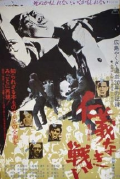
ninkyo films were considered as outdated. Kinji Fukasaku now brought a new ‘documentary style’ yakuza film series entitled
Jingi naki Tatakai or
Battles without Honour and Humanity, aka
The Yakuza Papers (1973). As the title suggests, this was the antithesis of
ninkyo, as it no longer praised the traditional code of conduct, but depicted the harsh survival of yakuza in the modern capitalist world as an exaggerated duplication of contemporary life with sordid brutality.
Daiei Studio also produced jidaigeki films, but these were straightforward entertaining action films in a medieval/pre-modern setting rather than advocating underlying traditional values. One of the most successful series produced by Daiei was Zatoichi ('The Blind Swordsman'), starring Shintaro Katsu.
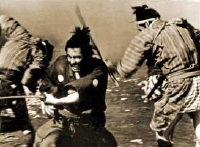
Toho Studio was more fortunate as it had Akira Kurosawa and the
Godzilla series. Kurosawa’s
Yojimbo ('Bodyguard', 1961) became the director's most commercially-successful film. It is well known that this film’s dynamism had a great impact on Hollywood and influenced the Spaghetti Westerns of Serge Leone, as well as the Kung Fu films of Hong Kong.
Shochiku maintained its taste for the comedy of everyday life, but struggled to produce hits. However, when it was given a chance to produce a film version of a popular TV series, Shochiku eventually gave birth to the most popular comedy-drama series ever made in Japan, Otoko wa tsurai yo or Tora-san, Our Lovable Tramp (1968-95 + 1997), with actor-comedian Kiyoshi Atsumi as Tora-san, an uneducated, child-like, petulant but kind-hearted man working as an itinerant crooked peddler.
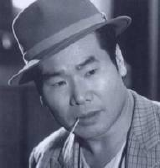
Director Yoji Yamada discerned the family and community around Tora-san in idyllic downtown Tokyo with an air of nostalgia, and prior to Kiyoshi Atsumi’s death in 1996 the series notched up the Guinness World Record for a film series with a total of 48 films! Despite its popularity at home, this series was not exported widely abroad, perhaps because its sense of humour and sentimentalism are peculiar to the Japanese. In a way the Tora-san series offers one of the best reflections of the Japanese culture and mentality, even though it was often blamed for its mannerism by Japanese film critics.
There was a period during the long inertia prior to Tora-san in which Shochiku enjoyed artistic fame for the ‘Shochiku Nouvelle Vague’, which begun in 1959 with Nagisa Oshima’s Ai to Kibo no Machi ('A Street of Love and Hope'). However, this Nouvelle Vague did not last long. Shochiku did not fully comprehend Oshima’s challenges, and when he made Nihon no yoru to kiri ('Night and Fog in Japan') in the following year, Shochiku voluntarily withdrew it from cinemas after four days of screenings, saying that it was too politically provoking. Disappointed, Oshima left Shochiku, and others with the same spirit followed him.
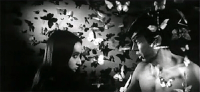
These ambitious film makers, with Oshima as the front-runner, kept producing experimental and provocative art films, gaining critical acclaims both at home and abroad. The Art Theatre Guild, founded by Kashiko Kawakita, supported these young talents from the 1960s through to 1980. Toshio Matsumoto made the first Japanese queer film
Bara no soretsu ('Parade of Roses', 1969) and Shuji Terayama shot
Sho o suteyo, Machi e deyo ('Throw Away Your Books, Go Out into the Streets! 1971)
Finally, mention should be made of ‘Pink’ and ‘Romantic Porn’ films. Porn films had been made in the programme picture system during the 1960s and the 1970s. Interestingly, although these films were categorised as porn, they should be read in wider context as they actually gave freedom to young directors to develop their film-making styles as long as the films included some sexual sequences.
Many experimental films were made under the name of ‘Pink’ and ‘Romantic Porn’ film, notably Koji Wakamatsu’s disturbing
Okasareta hakui ('Violated Angels', 1967) and
Kabe no naka no Himegoto ('Affairs Within Walls', 1965), and Tatsumi Kumashiro’s biographical film on a real-life stripper
Ichijo Sayuri (1972), which serve as good examples to prove that these films were not merely erotic programme pictures, but could be regarded as masterpieces with considerable artistic values.
There was more diversity in Japanese film making during the period discussed in this chapter; however, the industry did not stop subsidence as a whole.


