The second Golden Age (1952-1960)
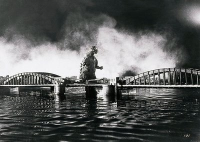
After the long period of suppression, Japanese directors were finally able to enjoy freedom of expression. This was the second golden age of Japanese film, lasting from 1952 to 1960.
The well-known Godzilla was first made in 1954 by Ishiro Honda, conveying a strong anti-war message by depicting fearful attacks by the monster, the catastrophe reminiscent to the audience of their terrifying experience of World War II, and in particular of the atomic bomb attacks. It gained both commercial and critical acclaim, and leading on from its success, monster films became an established genre unique to Japan. Unfortunately, later in the series, the sharp anti-war spirit was lost, and the films became mere monster battles for entertainment.
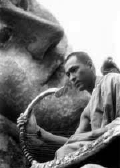
Another sort of anti-war film tended to depict Japanese citizens as victims in a mode of self-pity, such as the depiction of the Battle of Okinawa in Tadashi Imai's
Himeyuri no To ('Himeyuri Lily Tower', 1953) and of Burma in Kon Ichikawa's
Biruma no tategoto ('Burmese Harp', 1955). These films indicated that ordinary people were innocent, but were made to obey the orders of a ferocious military regime that commanded no surrender.
What makes the second Golden Age significant is the recognition of Japanese films at European film festivals. Ironically, American censorship during the occupation made Japanese film makers and producers revisit their own national tradition, which gave them insight into the wealth of their material and its ability to attract western eyes to Japan.
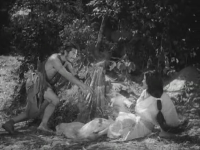
The first example is Akira Kurosawa, whose
Rashomon (1950) won first prize at the Venice Film Festival in 1951. Kurosawa did not anticipate his overnight fame. How could he expect such a surprising victory when Japanese film makers were not well acquainted with international film festivals? It was even an Italian who had recommended the film despite opposition from Japanese adjudicators. According to Donald Richie, the triumph in Venice saved Kurosawa, who feared he would otherwise have suffered a slump, failing to produce films that gave him high acclaim at home (
The Films of Akira Kurosawa, 1984). With this success, in the following year he shot
Ikiru ('Living')
, a sincere observation of post-war Japanese life focusing on a man who is dying of terminal cancer and tries to find the meaning of life. The film carries Kurosawa’s thematic concerns most skilfully.
Following this, from 1952 to 1954, Kenji Mizoguchi won consecutive awards at Venice for his Saikaku ichidai onna ('The Life of Oharu'), Ugetsu and Sansho dayu ('Sansho the Bailiff'). In 1954 Mizoguchi competed with Kurosawa’s Seven Samurai, and in the same year Teinosuke Kinugasa, former onnagata turned director, won the Palme d’Or at the Cannes Film Festival for Jigokumon ('The Gate of Hell').
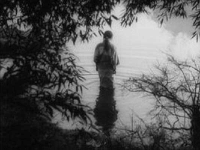
Why were these Japanese films spotlighted all of sudden in the European film market? First of all, these award-winning films were all historical costume plays that appealed to the European audience’s taste for Orientalism. Ozu’s films on contemporary life did not attract attention until much later. In his award speech, Kurosawa suggested that he would have been even happier if he were getting the award for having shown something of contemporary Japan (
ibid).
Indeed, After Kurosawa’s unexpected victory at Venice, Japanese directors became encouraged to produce films presenting exotic Japan to international audiences. Kurosawa himself said that Japanese were too critical of Japanese films (ibid); however, his unprecedented breakthrough into the international market had a positive influence on the Japanese film business. In addition, there was the influence of new auteur theory of film criticism represented by the French critiques Cahiers du Cinema, which allowed unknown directors from the Far East to compete with European directors under the same conditions. Mizoguchi and Kurosawa had both demonstrated their cinematic styles in the award-winning films mentioned above.
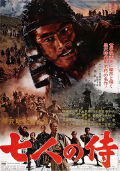
Although Kurosawa lost against Mizoguchi at Venice in 1954,
Seven Samurai is now considered both as Kurosawa’s masterpiece and as the most important epoch-making film, not only in Japanese film history but also in world cinema history. Its echoes have been heard ever since, from Westerns to animated features. Kurosawa claimed that
Seven Samurai was the genuine
jidaigeki or period film, providing a realistic portrayal of the medieval life of samurais and peasants, as well as being a compellingly entertaining film, full of thrilling action and comic and melodramatic elements (
ibid). Kurosawa also adapted Shakespeare’s
Macbeth to a medieval Japanese setting in
The Throne of Blood (1957), masterly merging the conventions of the
noh, the traditional theatre that Kurosawa called ‘the core of all Japanese drama’ (
ibid).
The second Golden Age was not confined to the international market. Nikkatsu Studio, once forced to close during World War II, reopened with new stars like Yujiro Ishihara, and produced entertaining programme pictures. Unlike jidaigeki superheroes who embraced traditional values, Ishihara was a new icon representing western narcissism. His first leading role in Ko Nakahira's acclaimed Kurutta Kajitsu ('Juvenile Jungle', 1956), a love triangle drama set against a modern urban backdrop, introduced the novel ideal of machismo in the post-war Japanese society. This film is said to have been spotted by directors of the French New Wave, ahead of their time!


