Ethnic minority architecture
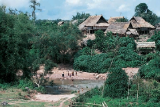
In the outlying rural and mountainous districts of the country, most ethnic minority groups live in small or medium-sized villages of stilted or non-stilted thatched houses constructed from wood and bamboo.
As a very general guideline it may be said that Tai-Kadai (Lao-Lu, Northern Tai, South Western Tai) ethnicities drawn from the Austro-Thai language family, together with Mon-Khmer ethnicities (Bahnaric, Katuic, Khmuic, Palaungic and Viet Muong speakers) drawn from the Austro-Asiatic language family, live in river valleys and on the lower hillsides in stilted or part-stilted houses, whilst mountain-dwellers such as the Hmong-Mien sub-groups of the Austro-Asiatic language family and members of the Sino-Tibetan language family show a preference for houses constructed directly onto the ground in the high plateaux. However, this is no more than a generalisation and many ethnic and regional variations exist - for instance in cases where members of one ethnic group living in close proximity to a more culturally dominant ethnic group have adopted the latter’s architectural style, or a mountain-dwelling ethnic group such as the Hmong has been resettled in a lowland area with a view to eradicating opium cultivation and encouraging settled agriculture.
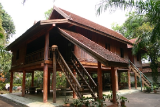
The residential housing of Tai-Kadai ethnicities varies significantly throughout the country in size and quality, from the rudimentary single-roomed bamboo house on stilts constructed by many Northern Tai ethnicities to the larger dwellings built by the Lu and by certain South Western Tai groups - most notably the large open plan stilted houses of the Tai Daeng, Tai Dam and Tai Khao, with their characteristic tortoise shell-shaped thatched roofs. Lao Isaan, Lao Ngaew and a few South Western Tai groups such as the Kalom and Phu Tai live mainly in houses of traditional Lao design.

In the past several Mon-Khmer ethnicities - including the Bahnaric-speaking Brau, Sedang and Yae, the Katuic-speaking Ca-tu, Katang, Kui, Pa-co and Ta-oi and the as yet linguistically unclassified Lavy - constructed stilted long houses measuring up to 30 or 40 metres in length, which provided living quarters for numerous extended families. Sizeable long houses were also built directly on the ground by the Lanten, a sub group of the Yao (Mien). Bahnaric and Katuic long houses were traditionally clustered around a communal house, where ritual ceremonies were performed, guests welcomed and important issues of the village discussed by elders. This communal house could resemble a larger version of the residential long house or alternatively take the form of an imposing structure known as the
rong house, which was characterised by its high ground clearance and steep two- or four-sided roof with sculpted finials. Today residential long houses and tall-roofed communal houses may still be found in remoter communities of southern Laos close to the Vietnamese border, but over the past 50 years communal house design has become simpler and there has been a trend towards the construction of smaller, more rudimentary stilted houses of bamboo and wood, grouped in clusters of between 20 and 100 and each accommodating just one nuclear family.
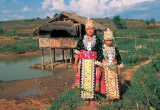
In contrast to the Bahnaric and Katuic groups of the south, representatives of the Khmuic, Palaungic and Viet-Muong branches of the Mon-Khmer language group of northern Laos tend to live in more rudimentary stilted dwellings made predominantly from bamboo.
A common feature of many settlements belonging to ethnic minorities of Mon-Khmer extraction is the bamboo spirit gate which marks the boundary of the village. A buffalo-sacrificing ground may often be found nearby.
Like the Hmong, Yao and Haw, most ethnicities of Sino-Tibetan language family construct their wood and bamboo houses directly onto the ground in mountain clearings. Notable exceptions are the Akha, Kongsat, Phanna and Phunoi, who build stilted or part-stilted dwellings.


