Ethnic minority performing arts
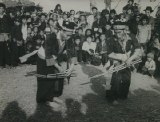
Many of Laos' ethnic minority groups preserve distinctive music and dance traditions, which function together with the production of art objects to propitiate the spirits and celebrate social milestones in the lives of members of the community.
Numerous different types of musical instrument are utilised in accompaniment of solo and group songs and dances.
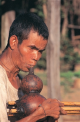
Wind instruments are found amongst almost all ethnic groups and range from vertical and transverse bamboo flutes to single and double reed wooden trumpets and buffalo horns. However, the most ubiquitous wind instrument in Laos is the
khene, which is used not just by the Lao ethnic majority but also by many other Tay-Tai speaking groups. The Hmong also have their own distinctive version of this instrument.
Stringed instruments are also popular and range from plucked gourd lutes to bowed bamboo fiddles.

Percussion comes in various shapes and sizes, ranging from bronze drums and gongs to wooden bells, bamboo clappers, chimes and even pestles and mortars. Bronze drums carry great ritual significance in the wider South East Asian region, and in Laos, as in neighbouring Việt Nam and Cambodia, they constitute an integral part of ritual ceremonies amongst Mon-Khmer and Lolo-Burmish groups.
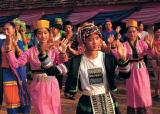
Fokloric dance remains an important means of celebrating everyday events and pastimes. Many different varieties of ethnic minority folkloric dance are performed in Laos, ranging from the xoe and sap (bamboo pole) dances of the Tay-Tay speaking groups to the robam of the Khmer, the khene and umbrella dances of the Hmong and the bell and drum dances of the Yao.
Complementing the
lam and
khap of the Lao ethnic majority, several Tay-Tai speaking ethnic minority peoples preserve their own call-and-response dialogue song traditions in which boys and girls engage in flirtatious vocal banter.
Best-known are khap tai daeng (Red Tai) and khap tai dam (Black Tai) from the Tai ethnic minority of Samneau Province, lam meuy from the Tai Meuy ethnic minority of Borikhamxai Province and, from the Phu Tai ethnic minority, lam phu tai in Savannakhet Province and khap phu tai in Phongsali Province. These genres sometimes employ a khene, but performances are more commonly accompanied by ethnic minority instruments such as bamboo flutes or fiddles, or simply by hand clapping.


 The rich performance traditions of Laos' ethnic minorities are currently being documented and researched with a view to revival and development through the auspices of the Ministry of Information and Culture's