Buddhist sculpture
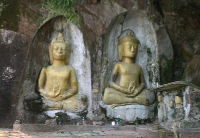
The earliest Buddha images found within the territory of present-day Laos are those of the Mon and Khmer kingdoms of the first millennium CE. Dvaravati-style Mon Buddha images may still be seen today carved into the rock face at
Vangxang, north of Vientiane, and several Mon and Khmer Buddha sculptures recovered from the central and southern provinces have found their way into museums, the most noteworthy being those housed at
Ho Phra Keo in Vientiane.
According to legend, Laos’ most famous Buddha image - the sacred pha bang - was originally cast in Sri Lanka, but its typically post-Bayon Khmer features betray its real origins.
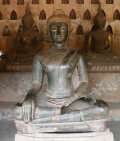
The design of the earliest indigenous Buddha images dating from the period is heavily influenced by that of the
pha bang, but by the early 16th century a distinctive Lao style had begun to develop. From the reign of King Wisunarath (), Lao Buddha images began to display a characteristic beak-like nose, extended earlobes, tightly-curled hair, and long hands and fingers.
At this time too there also appeared two mudras (gestures) that are found only in Lao Buddhist sculpture - ‘Calling for Rain’ (in which the Buddha stands with both arms held stiffly at the side of the body, fingers pointing downwards) and ‘Contemplating the Tree of Enlightenment’ (in which the Buddha stands with hands crossed at the wrist in front of the body).
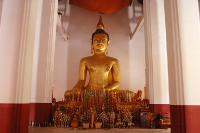
The period from is generally regarded as the ‘golden age’ of the Lao Buddha image, and many magnificent examples of religious sculptural art from this period may still be seen today in
Ho Phra Keo,
Wat Sisakhet and the
Luang Prabang National Museum. However, with the demise of Lane Xang and the growth of Siamese influence in the region during the 18th century, Lao sculptors fell increasingly under the influence of the contemporaneous Ayutthaya and Bangkok (Rattanakosin) styles. By the French colonial period decline had set in, and Buddha images were cast less and less frequently.
Lao Buddha sculpture uses a variety of mediums, including bronze, wood, gold and silver and precious stones. Of these, bronze is by far the most common and was used to create many important Buddha statues, including the colossal images at
Wat Manorom in Luang Prabang (14th century) and at
Wat Ong Tu and
Wat Chanthaburi (Wat Chan) in Vientiane (16th century). Smaller images were often cast in gold, silver or precious stone, while wood and ceramics were popular for the tiny, votive images found in cloisters or caves.


