Lam luang – Lao popular opera
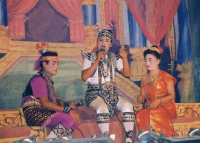
During the latter half of the 19th century new popular musical theatre genres were beginning to emerge throughout South East Asia in response to the needs of the growing urban population. The activities of the itinerant
bangsawan theatre troupes from Malaysia were an important catalyst in this process, creating a ready market for more entertaining and realistic styles.
In Laos there emerged during this period a theatrical derivative of lam pheun known as lam luang, a colloquial combination of singing and storytelling combined with improvisation, action and dance which was performed to a musical accompaniment. Lam luang is thought to have originated when the moh lam began to act out all the parts in his story, changing his costume and movement with each character. However, under the influence of Siamese likay, Cambodian yike and Vietnamese cải lương, this convention was gradually adapted so as to involve an ensemble of up to 30 people, each performing the various roles. From an early date musical accompaniment included both traditional Lao and western instruments.
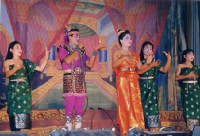 Lam luang
 continued to be performed on an amateur basis until 1972, when the
Central Lao Opera (Lam Luang) Troupe was established in the north of the country by the Pathet Lao with a view to the promotion of
lam luang as a national art form of the people. After 1975 that troupe helped to set up a second
lam luang company within the
Luang Prabang Provincial Performing Arts Troupe, which operated for five years before being disbanded.
Though no longer popular in the cities, lam luang has retained its appeal in rural areas of Laos and consequently the Central Lao Opera Troupe gives priority to touring the country performing and assisting in the creation and development of local lam luang troupes.
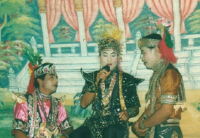
Nowadays much of its work involves educational and social theatre activities focused on AIDS education, drug awareness or health-related issues. The company also functions as the country’s only training centre for
lam luang, since the art form itself has never been taught at the
National School of Music and Dance.
Sadly a fire in 2000 destroyed the Central Lao Opera Troupe's headquarters along with its entire wardrobe of traditional costumes and archive of valuable old documents and photographs on lam luang. The company has since been obliged to reconstruct much from memory.


 Several other