Modern and contemporary visual arts
In the period after independence, the colonial emphasis on traditional arts was inflected with a new interest in ‘the modern’. A section of so-called ‘modern painting’ (representational painting) was founded at the School of Cambodian Arts in the late 1940s.
By the late 1950s representational drawing, painting and sculpture formed a substantial portion of the curriculum of the School, while traditional painting, mask making, silversmithing and weaving continued to be taught in individual sections.
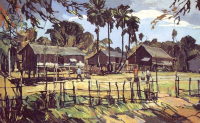
The government encouraged ‘modern Khmer’ art, supporting the development of new areas of specialisation (design, fabric design, modern ceramics, modern painting) at what was by then the University of Fine Arts, while purchasing ‘modern Khmer art’ for then-Prime Minister Sihanouk’s multiple residences, as well as for the government complex at Chamkar Mon. A number of individual galleries were established in Phnom Penh during the 1960s. The painter Nhek Dim opened a riverfront space where he sold his own paintings and those of a few relatives. In addition, a Khmer Artists’ Association held annual exhibitions and later established its own gallery directed by Sam Yuan. The French Cultural Centre (operational until 1975) and the American Library (active until 1964) hosted exhibitions of Khmer, French and American painters, in addition to providing libraries with books on a wide variety of artists and art movements.
Many artists were killed during the subsequent Khmer Rouge era and most art production ended. However, some painters were employed during the Democratic Kampuchea years as draftsmen, drawing plans for provincial irrigation and road building projects sponsored by the Khmer Rouge regime. The duties of these draftsmen included painting large roadside signs concerning maternal health and malaria prevention; they also prepared banners of slogans for provincial meetings.
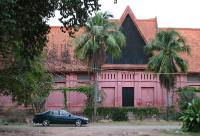
Following the fall of the Khmer Rouge, professors and artists associated with the University of Fine Arts returned to Phnom Penh and restarted training in the arts, slowly rebuilding the institution as well. A series of Socialist Bloc-sponsored scholarships subsequently allowed a whole generation of young art students to study for higher degrees in Poland, Bulgaria, the former Soviet Union and Hungary during the late 1980s and early 1990s. At the same time, initiatives by the first Deans of the Faculty of Plastic Arts, as well as the efforts of private Khmer collectors and Cambodian artists, allowed workshops to be re-established, documents to be collected and forms of knowledge to be preserved.
Several art galleries and exhibition spaces have opened in Phnom Penh which present changing exhibitions.
Reyum Institute of Arts and Culture has maintained a focus on researching, documenting and presenting exhibitions on Cambodian art and cultural history. Other gallery spaces, notably
Java Café and Gallery, have presented contemporary works by Cambodian and foreign artists.
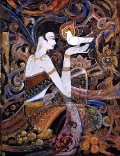
However, the vast majority of painters and sculptors support themselves in two ways: they either supply Angkor-inspired paintings and sculptures for the tourist market, or they paint the commercial signs and large-scale reproductions which in the west are mechanically produced. Among visual artists in Cambodia today who reserve some of their time to make their own work, it is possible to discern several groups and ways of proceeding. Old masters such as Som Samai (silversmithing), An Sok (mask making), and Chet Chan (traditional painting) produce high-quality pieces which follow forms instilled by the colonial art school that today are considered ‘traditional Khmer art’.
Contemporary artist Chhim Sothy’s work follows on from this school, using traditional techniques and imagery to produce intricately detailed work. Chhim Sothy and colleague Mak Remissa are also accomplished photographers, producing naturalistic scenes of people and the countryside in black and white.
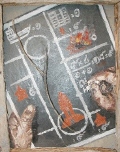
A group of young artists who studied abroad during the 1980s consciously try to create ‘modern Khmer art’; among them, Phy Chan Than, Soeung Vannara and Long Sophea make paintings which combine subject matter from Khmer culture with forms borrowed from western modernism, while Prom Sam An assembles sculptures which use forms from rural Khmer culture (the
ka-am, the water wheel) but translate such forms into a modern idiom.
Cambodian-trained artist Leang Seckon takes these approaches further, using sewing, painting, metalwork and collage in ways that reference Cambodian traditions, from apsara ballet to fortune-telling, while subtly commenting on modern culture, society and politics.
Pich Sopheap works in a variety of mediums including oil painting, photography and sculpture - he founded the Cambodian contemporary art association
saklapel.org with Linda Saphan. Through its website and curatorial efforts Saklapel seeks to exhibit the most prominent Cambodian artists in Cambodia and outside. It also hopes to create a sense of art community amongst visual artists. In 2005 Saklapel launched the
Visual Art Open (VAO), an annual event which features work by Cambodian artists.
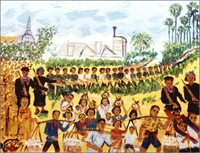
Other notable ‘modern’ work includes the
naïve-style paintings of Svay Ken, a self-taught painter who produces scenes of everyday life, and Asasax, whose
apsara reliefs fill his gallery/studio across from the National Museum. Most recently, younger newcomers Chhan Dina, Lam Soeung and Chhorn Bun Son have produced original and well-finished paintings, drawings and clay sculptures through their work together at Studio 310.
In the 1990s, the Khmer diaspora began returning to Cambodia. Among them are artists who have exhibited internationally and have chosen to make a base in their ancestral land. Cambodian-born Marine Ky, whose work is part of the Australian National Gallery collection, has spent most of her life in France and Australia. Her prints and installations use local materials and Khmer motifs, suggesting ‘a tentative path to retrieve ancestral memories’ (Sasha Grishin, 2003). US-born Chath Piersath is a community development worker whose stylised portraits of Cambodians provoke social comment.
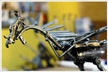
In late 2003, the Peace Art Project Cambodia began training young Cambodians in welding, forging and machining skills, producing over 100 pieces of sculpture and furniture from discarded weapons, ammunition and ordnance. These witty and accomplished pieces by Khmer artisans were permeated with a message of peace in their very forms. The project, which ended in 2005, enjoyed the support of various visiting artists, including Sasha Constable, great-granddaughter of English landscape artist John Constable.
In 2007 German filmmaker Nicolaus Mesterharm opened the
Meta House Phnom Penh, which provides space for creativity by both Cambodian and visiting artists.


