Royal Academy of Cambodia (RAC)
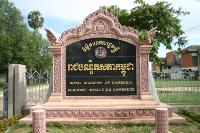
The
Royal Academy of Cambodia (RAC) was originally established by a Royal Decree of 25 August 1965 and placed under the Office of the Council of Ministers. However, by the time war broke out in Cambodia in 1970 it had still not started operations, and in the following years it disappeared completely amidst the turmoil of the Khmer Rouge period.
Efforts to revive the Royal Academy began in March 1997 with the establishment of the Academy of Cambodian History, later the Academy of History. In 1999 this institution became the Royal Academy of Cambodia (RAC), with five sub institutes - the Institute of Biology, Medicine and Agriculture, the Institute of Culture and Fine Arts, the Institute of Humanities and Social Sciences, the Institute of National Language, and the Institute of Science and Technology.
A public institution with a cultural and scientific mandate, managerial and financial autonomy and the status of state secretariat under the Office of the Council of Ministers, the Royal Academy of Cambodia is responsible for: (i) managing and expanding research activities on Khmer studies and other fields of study in Cambodia; (ii) establishing co-operative relations in research with ministries, institutions, national and international organisatirons which have the same goals; (iii) organising scientific and educational forums in order to help the country's development in all fields; (iv) training researchers for the Masters degrees and Doctorates; (v) widely distributing documents and research findings in the national language for the public in the country and Khmer studies in foreign languages for the international audience; (vi) collecting and preserving research findings on Cambodia, countries in the region and the world; (vii) bringing together national intellectuals with a view to fostering the country's development; (vii) proposing scientific decorations for national and international dignitaries; (viii) co-operating in the examination and evaluation of higher, including postgraduate, education; (ix) participating and co-operating in the protection of intellectual property; (x) examining and evaluating scientific research findings; (xi) examining and evaluating social evolution and contributing to the development of the country; (xii) co-operating in the establishment of research institutes at ministries; (xiii) establishing and managing branches of the Royal Academy of Cambodia at the regional level throughout the country; and (xiv) co-operating with relevant ministries for the establishment and management of prehistory and history museums in cities and provinces.
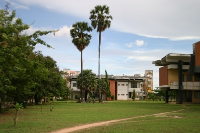
Since 2003 the Academy has offered a range of Masters and Doctoral programmes. It promotes research and organises scientific forums with a view to actively contributing to the development of human resources in Cambodia. The Royal Academy organised the first National Conference on the Preservation and Development of Khmer Culture and Fine Arts in April 2001 and the second conference in October 2004.
At the time of writing a fifth sub institute - the Institute of Continuous Learning - is being established with the aim of upgrading the capacity of the public service in order to strengthen Cambodian state institutions.


